

Our Camas 2045
We're in the Final Stretch
After more than 3½ years of collaboration, conversation, and community input, we are excited to be in the final stages of adopting Our Camas 2045!
This milestone reflects thousands of comments, ideas, and conversations shared by residents, businesses, community organizations, and other stakeholders throughout the planning process. Your feedback has directly shaped the vision, goals, policies, and priorities reflected in the plan, helping ensure that Our Camas 2045 represents the community's aspirations for the future.
Throughout the Our Camas 2045 process, we have incorporated community feedback, refined and strengthened the plan, coordinated with Clark County on countywide planning policies, and completed the Environmental Impact Statement (EIS). At the same time, we have advanced the zoning code and development regulation updates needed to implement the plan's goals and policies. Together, these efforts have created a roadmap for guiding Camas' growth, preserving its character, and enhancing quality of life for years to come.
We are now ready to take this important final step. Review the materials, attend upcoming hearings and workshops, and continue to help shape the future of Camas by sharing your comments during the adoption process.
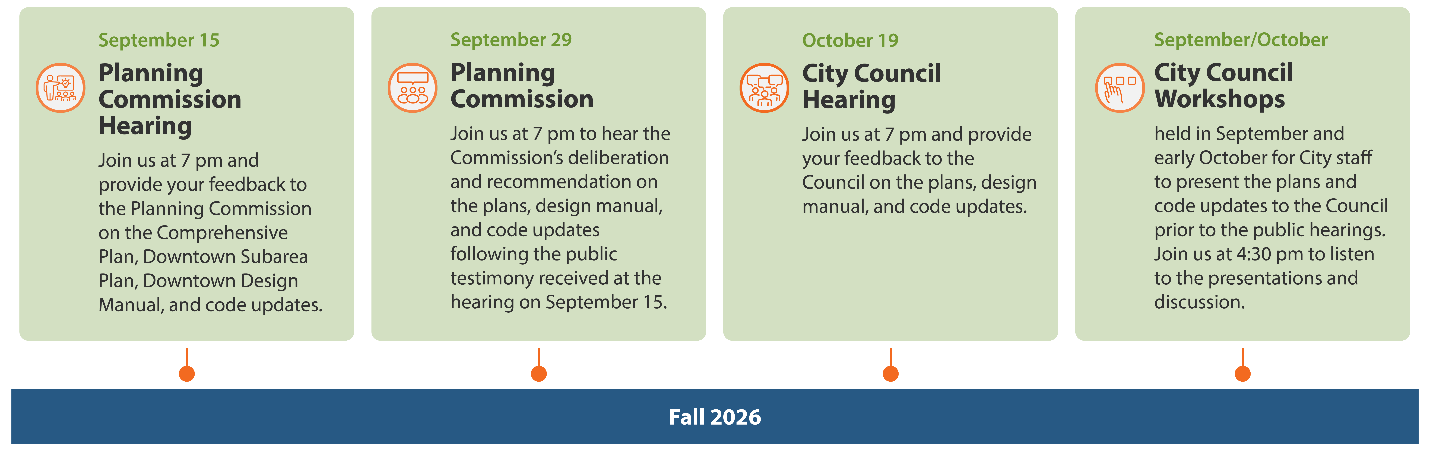
- On September 29, the Camas Planning Commission recommended that City Council adopt Our Camas 2045, Our Downtown Camas 2045, and associated zoning code and development regulation updates.
- On October 13, the Clark County Council approved the County's Comprehensive Plan update, which included approval of Camas's Grove Field Urban Growth Area expansion proposal.
- On October 19 at 7 PM, the Camas City Council will hold a public hearing to consider the Planning Commission's recommendation to approve Our Camas 2045 and Our Downtown Camas 2045. Meeting information is available at www.cityofcamas.us/meetings.
Adoption Schedule:
In April, the Clark County Council selected a preferred land-use alternative for the county's 2045 Comprehensive Plan update. Councilors rejected the "No Action" alternative and voted in favor of Alternative 2, which includes an expansion to the Camas Urban Growth Area to include the Grove Field Airport. This was the alternative recommended by the Clark County Planning Commission. However, the Clark County Council decided to save its decision on the de-designation of agricultural resource lands and eastward UGA expansion for housing in Camas for a later motion.
Clark County analyzed the preferred alternative and completed the final environmental impact statement (FEIS). Related plans and documents will be updated to reflect the preferred alternative. The FEIS was issued on July 24, 2026 and an addendum was issued on August 12, 2026.
Community Summit #3 was designed as a series of focused conversations on the draft Our Camas 2045 Comprehensive Plan and Our Downtown Camas 2045 Subarea Plan. From September through December 2025, we highlighted different comprehensive plan elements, including the subarea plan, with background information and a short online survey. The summit provided a chance to review the draft plans, get more information, share feedback, and help shape the next drafts.
A summary of Community Summit #3, including all survey results and comments received throughout the summit, is available under Project Documents. Each survey included questions focused on actions the City could take related to goals and policies for each element. Broadly, community feedback from the surveys focused on actions such as preserving open space and encouraging growth in developed areas of the city through infill and mixed-use development or ADUs. Improving transportation safety, supporting environmental cleanup, and planning for economic development were among the other actions recommended by community members.
The general schedule of the summit is shown available under Project Documents. In addition to the online component, community members were able to chat with a planner in person at a series of events.
Camas developed a preferred land use alternative map as part of the Our Camas 2045 Comprehensive Plan update process. This map will help the City achieve the new community vision and provide capacity for the next 20 years of anticipated growth.
Please visit our interactive online map to explore proposed changes at a parcel level, learn more about proposed land use types throughout Camas, and provide feedback.
The Our Camas 2045 Community Vision sets a roadmap for the community for the next 20 years. Over approximately seven months, from December 2023 through June 2024, community members were asked to share their thoughts on what makes Camas special today and what they would like to see in the future. The Our Camas 2045 visioning process reached over 1,000 community members through Community Conversations, Community Events, a Community Summit, an online survey, online mapping tools, and the Engage Camas project website. We heard a lot about maintaining Camas’ small-town feel and natural beauty and a desire for housing diversity and affordability, improvements to walkability and trail connectivity, and a need to celebrate Camas’ rich history and diversity. Take a look at the outreach summary under "Project Documents" to learn more! This process resulted in the Our Camas 2045 Vision Statement, which the City Council adopted in July 2024.
The comprehensive plan is the City's primary controlling document for land use and development. The comprehensive plan represents the community’s vision for the future of Camas.
The plan contains a comprehensive plan map that identifies land use designations, such as commercial, low-density residential, and high-density residential. The map depicts how and where the city will grow and change over the next 20 years to accommodate population and job growth while remaining consistent with the community’s vision. The current comprehensive plan map will be updated to reflect the community vision, ensure there is enough land to meet the city’s housing and employment allocations, and to address new state legislation that requires housing that is affordable at various income levels. For more information about the comprehensive plan update, see the “About the Comprehensive Plan Update” section below.
The City of Camas is undertaking a multi-year initiative to update the City’s comprehensive plan. The Our Camas 2045 Comprehensive Plan will establish a vision for our community and will articulate goals, objectives, policies, and actions to guide growth and development through 2045.
Why are we updating the plan? Washington’s Growth Management Act (GMA) requires every county and city in the state to conduct a periodic update of their comprehensive plan and development regulations. The purpose of an update is to reevaluate and update the goals, objectives, policies, and actions in response to public input, new state requirements, and changes in the existing conditions or anticipated future conditions.
A lot has changed since Camas’ comprehensive plan was last updated in 2016. We have seen our population grow quickly, as well as changes in our community’s demographics, businesses and industries. In addition, new state legislation on housing and climate change has been introduced requiring updates to the housing element and the addition of a climate element.
- HB 1110: Known as the “middle housing” bill, HB 11101 aims to increase housing options by requiring cities to allow more types of residential structures, such as duplexes, triplexes, and townhouses, in single-family areas. This bill requires Camas to allow up to two residential units per lot in all areas where single-family housing is allowed or up to four units within a ¼ mile of a major transit stop or if two of the units are affordable.
- HB 1220: This bill requires cities to “plan for and accommodate” housing affordable to all income levels, including moderate, low, very low, and extremely low income households and provide for moderate and high density housing to meet this need. The bill also requires the City to review programs, actions, policies and regulations that might be a barrier to new housing production and availability, including those that may have contributed to racial disparities.
- HB 1337: This bill requires the City to allow up to two accessory dwelling units (ADUs) on residential properties. ADUs are smaller housing units on properties with an existing primary dwelling unit, and the City currently allows one ADU on residential properties.
- HB 1181: This bill requires Camas to develop and adopt a new climate element (or chapter) in the comprehensive plan. The element must identify actions to reduce greenhouse gas emissions and identify strategies to improve the community’s resilience to hazards associated with climate change (e.g., wildfires, drought).
How do you know how much housing and employment to plan for over the next 20 years? The Washington Office of Financial Management provides population projections and the Washington Employment Security Department provides employment projections to counties throughout the state. The counties then allocate a share of those projections to each entity within its jurisdiction based on the land available within the city to support more housing and jobs. Based on Clark County’s allocations, Camas will need 4,226 new housing units and 11,615 new jobs over the next 20 years. The comprehensive plan update must plan for this growth and ensure available land and infrastructure is available to support the projected housing and jobs needs.
What goes in a comprehensive plan? Comprehensive plans are organized into planning elements, or chapters, that include a vision, overview, goals and policies specific to each element. Our Camas 2045 will develop the following elements:
- Community Character (new) – will describe the desired character of the built and natural environments in the city based on the community vision.
- Climate (new) – will address how the city is planning for the effects of climate change and identify actions for a more resilient community. See additional details below.
- Land Use – will identify the location and type of different land uses throughout the city. This element includes the updated comprehensive plan map.
- Housing – will address how the city will provide a diverse range of housing options to support community members at various income levels, as required by HB 1220.
- Natural Environment – will address the city’s natural environment, including its tree canopy, and actions to support its preservation.
- Transportation – will address the transportation system needed to support anticipated growth and development.
- Public Facilities and Services – will address utility and public service needs to support anticipated growth and development.
- Economic Development – will address the city’s goals for economic development and actions needed to support job growth.
What will go in the climate element? As noted above, HB 1181 requires the adoption of a climate change and resiliency element, which includes Greenhouse Gas (GHG) and Resiliency sub-elements.
The purpose of the GHG sub-element is to identify actions Camas will take to:
- Reduce overall GHG emissions generated by transportation and land use;
- Reduce per capita vehicle miles traveled; and
- Prioritize reductions that benefit overburdened communities.
The purpose of the Resiliency sub-element is to identify actions Camas will take to:
- Equitably enhance resiliency to, and avoid or substantially reduce the adverse impacts of, climate change in communities and ecological systems.
- Prioritize actions that benefit overburdened communities that will be most impacted by natural hazards due to climate change.
Clark County recently completed an analysis of local and regional climate data, including GHG emissions and vehicle miles traveled, which provides a benchmark for Camas to reduce GHGs and vehicle miles traveled through our comprehensive plan. A variety of community events will provide opportunities for community members to contribute ideas on how we can reduce our emissions and improve Camas’ climate resiliency.
Our Camas 2045 is guided by three advisory committees – the Community Advisory Committee (CAC), Project Advisory Committee (PAC), and Climate Policy Advisory Team (CPAT). The committees review and comment on draft products, guide public outreach and engagement efforts, provide technical and professional direction, act as liaisons to specific interest groups, and act as champions of Our Camas 2045. Committee rosters and meeting summaries can be found under the Project Documents tab on the right side of this page.
Multiple outreach events and activities have been held to provide community members with opportunities to engage in the planning process and share your ideas. The City hosted three community summits to provide in-person and online engagement opportunities for Our Camas 2045 (see Project Documents). Community summits were held in 2024 and 2025 and were advertised to the community through various channels, such as Engage Camas, social media (Instagram and Facebook), media releases to the Camas-Washougal Post Record, and emails to community members who had signed up for project notifications. Other events and activities included advisory committee meetings, community conversation kits, and the Our Camas 2045 table at First Fridays, the Farmer's Market, and Camas Days.
Three advisory committees were created to provide broad community representation during Our Camas 2045. Community conversation kits served as a meeting facilitation tool to help advisory committee members facilitate discussions with community members and a community conversation tracking log documented when the conversation kits were used to meet with groups and organizations in Camas. Examples of these groups included the Downtown Camas Association, Middle and High School student groups, Camas View Senior Care, and Clark County Transportation Alliance.
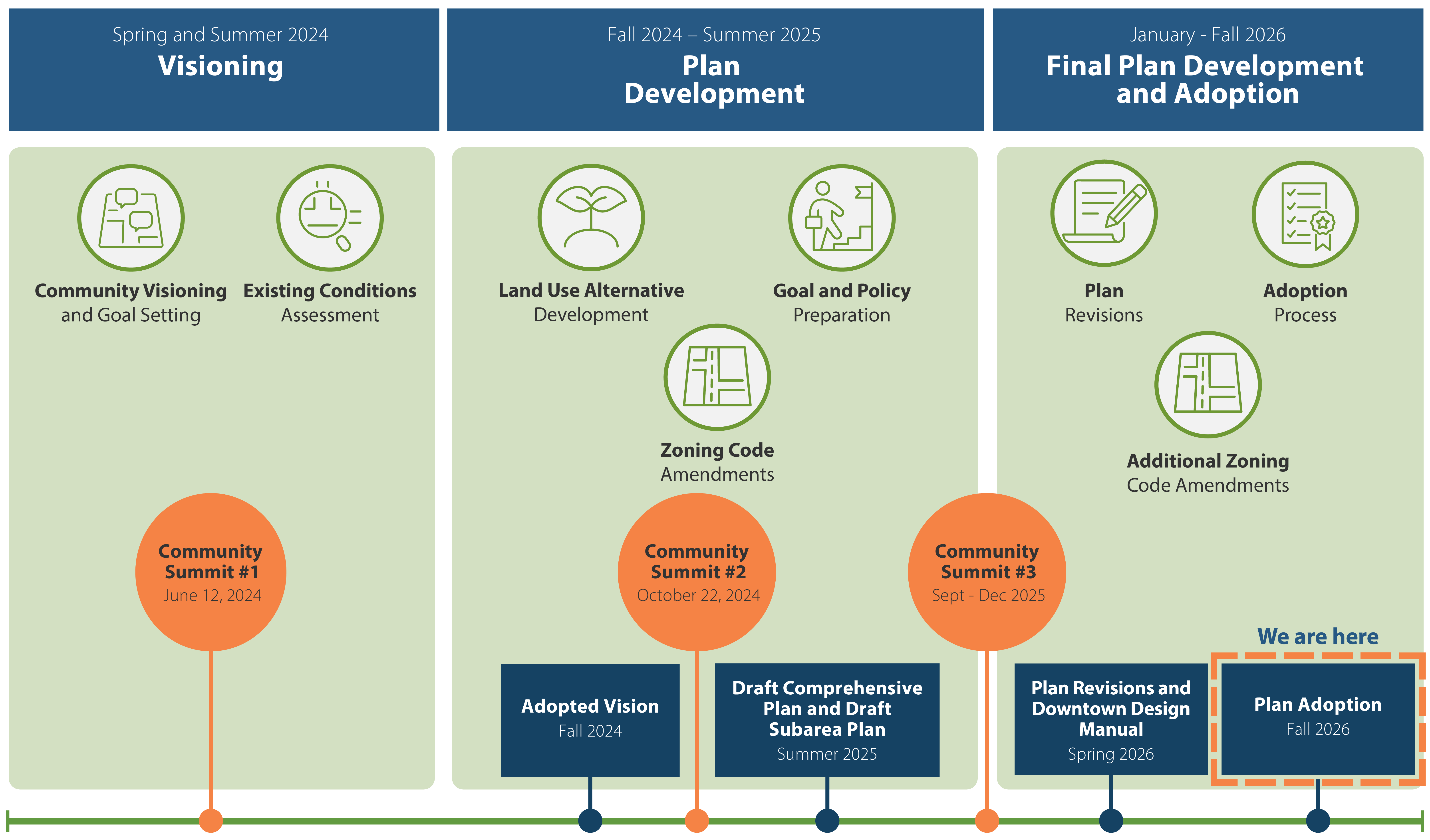
Prior to the first community summit, the City launched an online survey and mapping tool that allowed community members to share what they love and what can be improved throughout the city. A citywide mailer was also sent to all Camas residents to announce the launch of the project, promote Engage Camas, and provide details on upcoming engagement activities. An overview of the project schedule is provided below.
In conjunction with Our Camas 2045, the City developed a Subarea Plan for Downtown Camas. Our Downtown Camas 2045 sets a more detailed vision for Downtown Camas and included in-person and online engagement activities during the community summits to provide community members with opportunities to share their vision for the future of Downtown Camas (see Project Documents). Meetings with the Downtown Advisory Committee provided another opportunity for community members to review and share feedback on the Subarea Plan.
The next opportunities for community members to provide comments on the draft Comprehensive Plan and Subarea Plan will be by participating in the adoption process at City Council and Planning Commission meetings. Upcoming meeting dates and times are described above, and can be viewed on the City’s legislative meetings portal.
Survey
CLOSED: This survey has concluded.
Thank you for sharing your comments on the draft Comprehensive Plan! Your responses will help inform updates to the plan as the City prepares for final adoption. You can review a summary of the feedback from the survey in the Community Summit 3 summary under Project Documents. Additional opportunities to provide comments on the draft Comprehensive Plan and Downtown Subarea Plan will be available by attending City Council and Planning Commission meetings.[Survey Closed]
-
 Comprehensive Plan
-
Comprehensive Plan Appendices
-
 Appendix A Engagement Summaries.pdf (11 MB) (pdf)
-
Appendix B Housing Action Plan (2021).pdf (26.4 MB) (pdf)
-
Appendix C Housing Analysis (2024).pdf (2.31 MB) (pdf)
-
Appendix D Housing Needs and Land Capacity Analysis (2026).pdf (818 KB) (pdf)
-
Appendix E TSP (Draft 2024).pdf (5.51 MB) (pdf)
-
Appendix F Facility Conditions Assessment - Volume 1 (2021).pdf (1.43 MB) (pdf)
-
Appendix G Facility Conditions Assessment - Volume 2 (2021).pdf (5.63 MB) (pdf)
-
Appendix H PROS Plan (2022).pdf (11.6 MB) (pdf)
-
Appendix I POSMP (2025).pdf (23.2 MB) (pdf)
-
Appendix J Water System Plan (2019).pdf (43.1 MB) (pdf)
-
Appendix K General Sewer Plan (2022).pdf (14.1 MB) (pdf)
-
Appendix L Capital Improvement Plan (2025-2026).pdf (461 KB) (pdf)
-
Appendix M Stormwater Management Program (2026).pdf (3.08 MB) (pdf)
-
Appendix N Economic Opportunity Analysis (2024).pdf (3.22 MB) (pdf)
-
Appendix O 6-Year Street Plan (2027-2032).pdf (1.05 MB) (pdf)
-
Appendix P School District Capital Facilities Plan (2022).pdf (466 KB) (pdf)
-
-
Title 17 and Title 18 Amendments Package.pdf (3.98 MB) (pdf)
-
Downtown Subarea Plan
-
Project Overview and Vision
-
Community Summits
-
Community Summit 3 - Summary (515 KB) (pdf)
-
Community Summit 3 - Schedule.pdf (605 KB) (pdf)
-
Community Summit 3 - Draft Plan Elements.pdf (17.1 MB) (pdf)
-
Community Summit 3 - Posters.pdf (5.96 MB) (pdf)
-
Community Summit 3 - Handouts.pdf (849 KB) (pdf)
-
Community Summit 2 - Summary.pdf (535 KB) (pdf)
-
Community Summit 2 - Development Visual Preferences Boards.pdf (14.8 MB) (pdf)
-
Community Summit 2 - Downtown Boards.pdf (18 MB) (pdf)
-
Community Summit 2 - Climate Boards.pdf (596 KB) (pdf)
-
Community Summit 1 - Summary.pdf (647 KB) (pdf)
-
Community Summit 1 - Poster Boards (7.44 MB) (pdf)
-
-
Community Advisory Committee
-
CAC Roster (145 KB) (pdf)
-
CAC Meeting 1 - Agenda and Summary.pdf (1.01 MB) (pdf)
-
CAC Meeting 2 - Agenda and Summary.pdf (475 KB) (pdf)
-
CAC Meeting 3 - Agenda and Summary.pdf (415 KB) (pdf)
-
CAC Meeting 4 - Agenda and Summary.pdf (374 KB) (pdf)
-
CAC Meeting 5 - Agenda and Summary.pdf (200 KB) (pdf)
-
CAC Meeting 6 - Agenda and Summary.pdf (376 KB) (pdf)
-
CAC Meeting 7 - Agenda and Summary.pdf (339 KB) (pdf)
-
CAC Meeting 8 Agenda and Summary.pdf (6.7 MB) (pdf)
-
-
Climate Policy Advisory Team
-
CPAT Roster (127 KB) (pdf)
-
Greenhouse Gas Inventory.pdf (1.7 MB) (pdf)
-
CPAT Meeting 1 - Agenda and Summary.pdf (471 KB) (pdf)
-
CPAT Meeting 2 - Agenda and Summary.pdf (430 KB) (pdf)
-
CPAT Meeting 3 - Agenda and Summary.pdf (405 KB) (pdf)
-
CPAT Meeting 4 - Agenda and Summary.pdf (397 KB) (pdf)
-
CPAT Meeting 5 - Agenda and Summary.pdf (410 KB) (pdf)
-
-
Land Use Alternatives
-
Housing & Economic Analysis

